 My bro’ John just sent me this awesome article from the Washington Post that talks about the “No Toilet, No Bride” program. The Indian government is trying to encourage women to refuse marriage until their betrothed promises to provide them with… a toilet. Yep, India has the second largest population in the world, and more than HALF of their people still poop in the fields. Reminds me a lot of rural Guatemala, and one of the reasons we’re here: to educate people on the dangers of not having sanitary human waste disposal systems. We as Americans take sanitary sewers for granted, but many of us don’t even understand their importance. It’s not just about smell and the occasional gooey mess you step in after dark. Without proper disposal, the entire population is exposed to some pretty horrible health risks, from low-grade stuff like diarrhea and parasites, through more serious stuff like ameobic dysentery, all the way up to the really nasty ones like cholera (which killed some people in my village just 8 years ago!).
But the most striking quote from the article is this:
Previous attempts to bring toilets to poor Indian villages have mostly failed. A 2001 project sponsored by the World Bank never took off because many people used the latrines as storage facilities or took them apart to build lean-tos, said Ranjana Kumari, director of the Center for Social Research in New Delhi, who worked on the program.
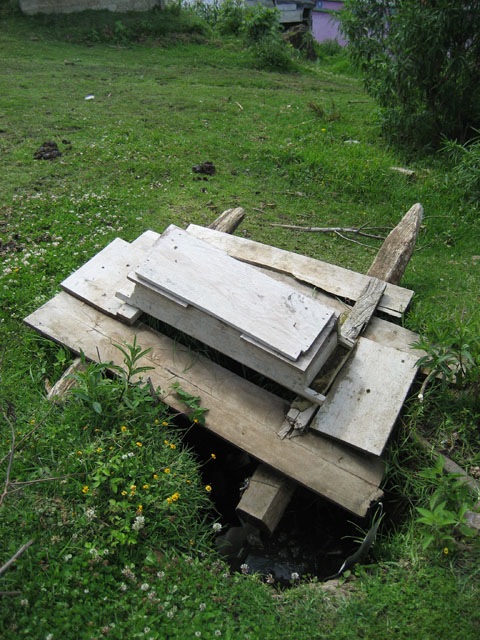
I guess some stuff is the same the world over. Peace Corps has changed its focus in the last two years, de-emphasizing construction and hammering home the education: if people don’t understand how something helps them, or why it’s important, then they won’t care for it. There are a fair amount of latrines in our area that look like the picture above, and I try not to walk in the cornfields at night…
Emily and I are still pushing forward with whatever technologies we think will help, though. One area of focus is “improved woodburning stoves”. The majority of the world’s 5 billion people cook with firewood, and most of THOSE people use open fires. This is bad for several reasons, but this biggest two are smoke inhalation (which causes acute respiratory infection, the #1 killer of kids and women in developing nations), and depletion of forests. Luckily, our village has a really high rate of wood stove use. Yay! But there is always room for improvement. Our friend and neighbor Nas Palas, for example, still cooks over an open fire. His family “just likes it”, he explained to us the day we ment him, and doesn’t really want to change. But we never give up, so when Marco Tulio took us on a factory tour of his stovemaking facility, we happily accepted the demonstration model he offered to give us for evaluation in our site.
The Ecocina is an interesting new stove design, sponsored by Nancy Hughes and our friends at StoveTeam International. Their team of engineers and researchers has optimized the design to be as efficient as possible while still performing the required tasks of a third-world kitchen. I won’t bore you with all the details, but it basically creates an intense, insulated fire in a carefully proportioned venturi stack. The stove itself is portable and inexpensive (400Q). This particular model, however, has one big drawback: no chimney. That knocks out half of the mission, the bit about reducing smoke in the home(1).
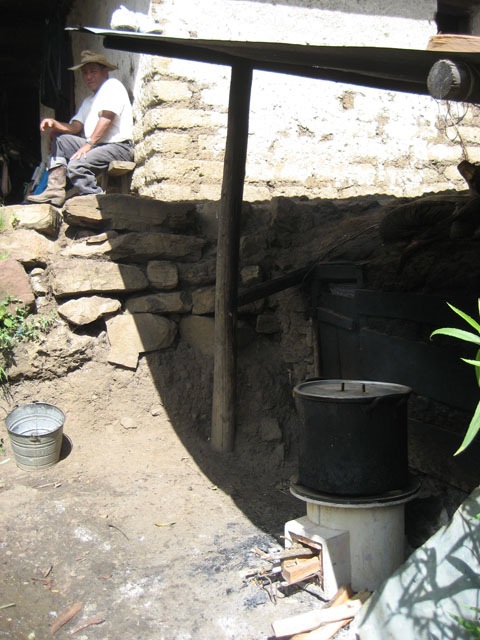 But in our situation, it has a second great use. Everyone here builds giant fires outside their chuj (steam bath) to heat bathing water. These fires are outdoors, so don’t cause household smoke. After some discussion, we were able to convince Nas’s family to try it for their bathwater. And if we can get them to like it, we can start spreading the news to other families, and maybe save some money and forests.
The fateful day arrived, and Emily and I moved the stove up next to their chuj. It caused quite a stir amongst the women, who were at first afraid of it, then moved it to the side to make a second fire next to the stove. “That tiny thing isn’t going to heat up enough water, we want a backup,” they said. Of course, Emily and I had tried it with their bathwater pot the week before, and we knew better.
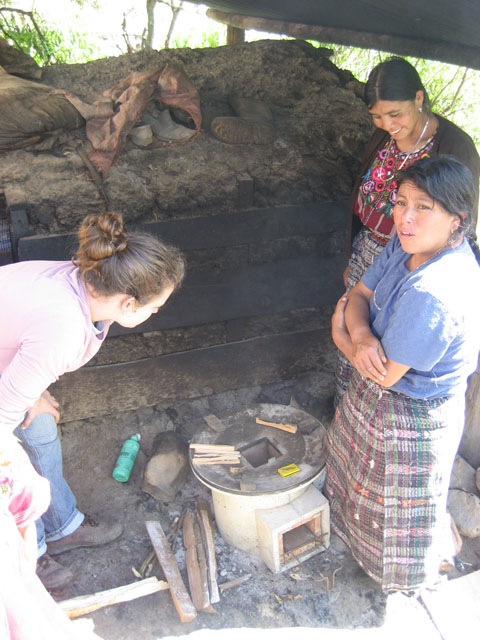 “Tell you what,” Emily challenged them. “We need to do a fair test. Try it with JUST the stove, and if there isn’t enough hot water, I will take your big ole’ pot back to my house and heat the rest of the water on my gas stove.” That was quite a boast, but it worked and we got our test. And, as predicted, we had hot water in an hour. The best part was watching people go gradually from amused skepticism to curious interest to surprised belief over the course of the afternoon. One of the women was particularly excited about it, Lena, and she is the quietest of the bunch. But I suppose our real test will come next week, when we see if they want to use it again.
Maybe that is the best part of what we’re doing: seeing small but important changes in the people that we’ve grown close to; exposing them to new but simple ideas that might make their lives better. I was talking to Galindo this evening, and realized how far he’s come. Next week he will be graduating from high school, and as we watched the sun go down, he talked with me about his hopes and dreams for the future. He wants to do the “extra year” next year, which will allow him to transfer into several different technical fields like teaching or nursing. That is serious white-collar employment in these parts. He paused, then told me he has even bigger dreams, but worries that there really is no way to afford them. “I want to be a doctor,” he admitted.
I want to set up a discussion with him and Dr. Diego, the doctor that we work with at the health center. Dr. Diego is also a Q’anjob’al Mayan, and got a scholarship to the medical school in Cuba. That is how the majority of Guatemalan doctors get their training. There are only 2 med schools in Guatemala, and combined they only graduate about a hundred doctors a year. Not enough to serve the 13 million people who live here, obviously. But if Galindo can do what’s needed to go to the Cuban school? That would be an amazing day not only for him and his family, but for the entire region.
That’s a far cry from trying to take his own life, less than a year ago.
(1) Some people at StoveTeam bill the Ecocina as “smokeless” and requiring no chimney, but a 100% clean burn is almost impossible, even under optimal conditions. The stove is still a great tool, though. Beside heating water outside, we are also want to introduce the stove in Barillas, a hot region where the houses have half-height walls and any combustion products can easily leave the home.